About the Needs-Based Finance (NBF)
The Needs-Based climate Finance (NBF) was established pursuant to Decision 6/CP.23, paragraph 10, and reaffirmed by Decisions 4/CP.26, 13/CP.27, and 4/CP.28. These decisions mandate the UNFCCC secretariat—working in collaboration with the operating entities of the Financial Mechanism, United Nations agencies, and bilateral, regional, and other multilateral channels—to explore ways to assist developing countries in assessing their climate finance needs, including finance, technology, and capacity-building, and in translating those needs into concrete action in a country-driven and regionally coordinated manner. Since its inception, the secretariat has partnered with 11 regional intergovernmental entities, supporting more than 110 developing countries. This collaboration has resulted in the development of nine Regional Climate Finance Access and Mobilization Strategies, each endorsed by the relevant Ministerial Councils or summits. In addition, a series of in-person and virtual training sessions and consultation workshops have been conducted in partnership with the Adaptation Fund (AF), Global Environment Facility (GEF), Green Climate Fund (GCF), and accredited entities to build capacity in climate finance access and project preparation.
Event overview
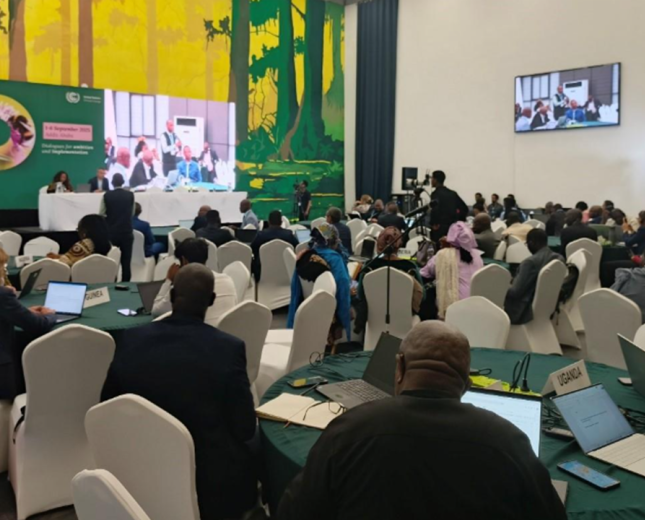
Mobilizing finance and accelerating high-impact climate programmes is a central theme of Africa Climate Week 2025, and in this context, the UNFCCC Secretariat – together with regional partners AUDA-NEPAD, the East African Community (EAC), and ECOWAS – convened the “Capacity Building for Accessing Finance (Needs-based Climate Finance)” workshop on 1–2 September 2025 in Addis Ababa. This intensive two-day workshop, delivered in collaboration with the climate funds and accredited entities, equipped country representatives with up-to-date knowledge of recent changes in each fund’s policies, programming priorities, templates and requirements. Sessions covered essential elements of project development, including how to establish a robust climate rationale, develop a compelling theory of change, leverage diverse funding sources, and set up effective implementation arrangements.
By the end of the workshop, participants flet they had gained a stronger grasp of climate fund processes and project review criteria, enabling them to design and submit stronger project proposals. Many also called for "Readiness, for Readiness, to get Ready", with almost 50% of countries having not yet tapped into more than half of the available readiness out there.
Discussions & Presentations
Day 1 (1 September 2025)
| Time |
Activity |
Presenter/Resource |
| |
Session 1 – Opening |
|
| 10:00 – 10:30 |
Welcome remarks, workshop objectives and expected outcomes. Master of the Ceremony Willie Otieno, Regional Lead, RCC East and Southern Africa, opened the workshop and invited remarks from UNFCCC and regional partners, underscoring the importance of the session in Africa’s climate finance context
- Mr. Simon Kiarie, Acting Director of Productive Sectors, East African Community
- Mr. Yao Bernard KOFFI, Director of Environment and Natural Resources, ECOWAS Commission
- Mr. Grant Kirkman, Team Lead, Country & Private Sector Engagement, Climate Finance, Means of Implementation Division, UNFCCC
|
|
| |
Session 2 – Key updates from the Adaptation Fund |
|
| 10:30 – 10:50 |
Ms. Bianka Kretschmer, Climate Change Specialist, Resource Mobilisation & Strategic Partnerships Department, Adaptation Fund, provided an update on operational and policy changes, access modalities and project development cycle, highlighting current programming and key priorities. Draw attention to specific trends, challenges, pipelines, and accreditation of national and regional entities.
Key points:
- About half of AF funding is delivered via Direct Access, reflecting its pioneering work to accredit national/regional entities so countries can access grants without intermediaries.
- Country cap doubled to USD 40 million, with extra grants for locally led adaptation, innovation, learning, scale-up, and readiness.
- Raised the limit for single-country projects to $25 million (and multi-country to $30 million)
- Countries can nominate up to two NIEs and benefit from readiness grants to support accreditation.
- AF proposals require no co-financing (AF grants can cover full project costs), but a strong adaptation rationale is essential.
- Scale-up potential should be embedded from the design stage through implementation, supported by targeted capacity-building.
- Project scale-up grants are available for NIEs
Presentation: AF PPT_ACW_Session 2_Key updates from climate funds
|
Moderator:
Mr. German Velásquez NBF Global Strategic Advisor
|
| |
Session 3 – Capacity-building session to enhance project review and preparation |
|
| 11:20 – 13:00 |
Part I – Key elements of Programme design: Theory of Change, climate rationale and implementation arrangements
In this interactive plenary discussion, the Adaptation Fund and the IGAD Climate Prediction and Applications Centre (ICPAC) elaborated on the key elements of programme design, with emphasis on the Theory of Change, climate rationale, and implementation arrangements.
Mr. Andrew Hollander, Climate Change Analyst, Programming and Innovation Team, Adaptation Fund – provided an overview of AF’s funding
criexpectations and the tools and support available to help improve proposals (e.g., guidance documents, analytical support), offering participants insight into what makes a strong proposal. AF PPT_Session 3_Climate rationale
Mr. Paulino Omoj Omay, Head of the Climate Change Unit, IGAD Climate Prediction and Applications Centre, emphasised that proposals require a clear and evidence-based climate rationale, demonstrating direct links between climate change and the problem, with impacts on vulnerable sectors supported by data and projections. He also highlighted the importance of attributing risks specifically to climate change, justifying adaptation or mitigation measures accordingly, and ensuring projects are distinct from business-as-usual development. – ICPAC PPT_ Session 3_Climate Rationale
|
Moderator:
Mr. German Velásquez NBF Global Strategic Advisor
|
| 13:00 – 14:00 |
Lunch |
|
| 14:00 – 16:00 |
Part II – Leveraging various funding sources and instruments & implementation arrangements
This session discussed the financial structuring for climate projects. Participants learnt several examples where various funding sources (public, private, multilateral) and instruments (grants, loans, equity, guarantees) were combined to fund large-scale programmes.
Mr. Komlanvi Moglo, Representative of the President to the International Development Finance Club (IDFC), West African Development Bank (BOAD) - A keynote to highlight innovative financing mechanisms (e.g., blended finance structures, public-private partnerships for climate projects) and how to “crowd-in” various funders, and point out key challenges and risk mitigation strategies
Case study deep dive:
- Mr. Harold Mogale, Climate Finance Specialist, Development Bank of Southern Africa (DBSA) Mr. Mogale presented a case study from the DBSA illustrating how large-scale climate programs can be financed through layered funding. He shared details of a climate-resilient infrastructure program in Southern Africa, where the DBSA arranged financing from multiple sources to achieve financial closure. In this example, DBSA blended concessional climate finance (from funds such as the GCF) with its own capital and that of commercial and local investors.
- Mr Gareth Phillip, Manager, Climate and Environment Finance Division, African Development Bank. Mr. Phillips presented AfDB’s experience with the Programme for Integrated Development and Adaptation to Climate Change in the Niger Basin (PIDACC), illustrating how AfDB helped assemble an extensive financing coalition to fund a USD 210 million multi-country climate resilience effort. The project, spanning nine countries, aimed to improve ecosystem resilience and livelihoods in the Niger River Basin. PIDACC/NB FP092 Financial structure.pptx
- Mr. Joel Sam, Associate Director, Energy Access for the Hardest-to-Reach, Acumen
Mr. Sam provided a private sector and civil society perspective, discussing how innovative finance is being utilised to expand access to clean energy in underserved communities. He presented Acumen’s “Hardest-to-Reach” Energy Access Initiative, which aims to scale off-grid renewable energy solutions in remote, low-income regions of sub-Saharan Africa. Acumen raised USD 65 million from the GCF as part of a USD 250 million blended finance facility to invest in off-grid solar companies and projects in markets that traditional investors consider too risky. This facility uses a mix of equity, concessional debt, and grants to de-risk investments in frontier markets and attract additional impact investors. - H2R- CW Sept 1 2025.pptx
|
|
| 16:00 – 16:30 |
Coffee/Tea Break |
|
| 16:30 – 17:00 |
Session 4: Update on the Fund for Responding to Loss Damage (FRLD).
Ms. Mathilde Laurans, Deputy Executive Director of the FRLD Secretariat, presented an update on the Fund’s start-up phase, which aims to support vulnerable developing countries in addressing economic and non-economic losses associated with climate change.
Key points
- USD 250 million available for programming for the 2025–2026 period.
- Board has adopted the Barbados Implementation Modalities (BIM), which set a 50% minimum allocation for SIDS and LDCs and provide grants ranging from USD 5–20 million.
- The Fund will follow country-led approaches, ensure coherence with national systems, and apply culturally sensitive and gender-responsive principles.
FRLD - PPT_CW2_Startup phase update 01_Sept
|
Moderator:
Grant Kirkman, UNFCCC
|
| 17:00 – 17:30 |
Session 5: Day 1 – Recap of key messages & closing PPT
- Sustainability and scalability are critical: Countries stressed that projects/programmes should be designed to last beyond initial public financing and must explore stronger engagement of the private sector to secure continuity. i.e. Project sustainability and scalability are central.
- Whole-of-government approaches were highlighted as the most effective way to ensure ownership and coordination across ministries and agencies when mobilising and managing climate finance.
- Stronger coordination among funds is needed to support DAs in mobilising resources for NAP and NDC implementation.
- There is high potential to use AF grants to generate evidence and learning from successful projects to make it easier to access financing from other funders such as climate funds, MDBs and the private sector.
|
Moderator:
Mr. German Velásquez NBF Global Strategic Advisor |
Day 2 – (2 September 2025)
Updates from the GCF and GEF & application and project refinement
| Time |
Activity |
Facilitator |
| 09:15 – 11:00 |
Session 6: Update from the Green Climate Fund and Global Environmental Facility presentation.
The fund representatives updated participants on operational and policy aspects, access modalities, and the project development cycle, highlighting current programming and key priorities. The session also drew attention to specific trends, challenges, pipelines, and accreditation of national and regional entities.
Key points
Ms. Chihenyo Kangara, Country Coordinator, Africa Department, Green Climate Fund Presentation
- Strategic priorities (USP2 2024-2027) include empowering developed countries through enhanced readiness; mobilising the private sector, improving access and protecting the most vulnerable.
- Increased readiness support envelope up to $ 7.32 million per country over 4 years through the country modality and $ 1 million per entity through the DAE modality. Additionally, up to $3 million is available for NAP.2 implementation based on a clear need & demonstrable impact on NAP implementation.
- There is an opportunity to use readiness to advance the implementation of regional initiatives such as the African Continental Free Trade Area (AfCFTA).
- GCF role and support for country platforms as a voluntary country-level mechanism to foster collaboration among development partners.
Mr. Ladu Lemi, Climate Change Specialist, Global Environmental FacilityPresentation
- Priority areas focus on scaling up finance through stronger coherence and institutional tools, fostering innovation and private sector engagement, and advancing an inclusive whole-of-society approach that strengthens institutions, equity, and partnerships.
- Countries can access GEF as a single fund or a combination of two different funds as a “Multi-Trust Fund Project”. A country can decide to access both the GEF Trust Fund and LDCF in a single project that addresses national climate adaptation and mitigation priorities
- As of June 2025, significant LDCF/SCCF resources remain available for African LDCs. Some countries have accessed only a small portion or none of their allocations, presenting an opportunity for stronger pipeline development.
- GEF and GCF are working towards joint national investment planning in select countries, harmonising policies, and coordinating financing platforms.
Preparations are underway for GEF-9 (2026–2030) Programming Strategy, with emphasis on operational improvements and scaling transformational adaptation.
|
Moderator:
Grant Kirkman, UNFCCC |
| 11:00 – 11:20 |
Coffee/Tea Break |
|
|
11:20 – 13:00
|
In this session, participants discussed the rationale for climate action, the theory of change, financing instruments, and implementation arrangements. The GCF outlined its expectations for project design, emphasising that proposals must clearly demonstrate climate impact, using climate data and aligning with its results framework.
Ms. Chihenyo Kangara, Country Coordinator, Africa Department, Green Climate Fund Presentation
Key points
Proposals must clearly demonstrate how the project addresses climate-induced problems (with data on climate impacts, projections, etc.) and why
- the proposed activities are additional to business-as-usual development. Link each project component to climate change drivers or vulnerabilities.
- GCF encourages blended finance approaches to crowd in public and private capital.
- Proposals should justify the choice of instrument(s), ensuring they match the project context and risk profile.
Reviewers note too ambitious ToC as to what can be changed, ToCs disconnected from the project structure and design, and involvement of a few stakeholders.
|
Moderator:
Grant Kirkman, UNFCCC
|
| 13:00 – 14:00 |
Lunch |
|
| 14:15 – 16:40 |
Refinement of regional programme ideas: Breakout room discussion and plenary report-back.
Participants were grouped into three sub-regional breakout groups – East, West, and Southern Africa- to discuss regional programme ideas and concepts. Each group had two pre-identified project ideas or concepts and a different agenda, depending on the level of advancement of the projects.
Group chairs:
- East Africa: Michael Ochieng' Okumu, Deputy Director, Climate Change Directorate, Kenya LVBC PPT
- West Africa: Mr. Raoul KOUAME, Programme Officer, Climate Change & Climate Services, ECOWAS Commission ECOWAS PPT RAAF PPT
- Southern Africa: Mr. Harold Mogale, Climate Finance Specialist, Development Bank for Southern Africa
Rapporteurs & presentations
- East Africa: Mr. Simon W. Kiarie, Acting Director, Productive Sectors, East African Community PPT
- West Africa: Mr. Oue Ada, Burkina Faso, PPT
Southern Africa: Ms. Aina-Maria Iteta, Business Strategy Executive, Namibia Environmental Investment Fund. PPT
|
Moderator:
Mr. German Velásquez NBF Global Strategic Advisor
|
| Day 2 Recap of key messages & closing |
|
16:40 – 16:45
|
Moderators recap & take away (excluded agreed next steps from the BoG session)
Key points
- Alignment between NDCs, NAPs, long-term strategies, and project pipelines is essential to ensure project viability.
- Underserved countries require enhanced focus, including the capacity to manage fragility and conflict.
- Climate funds are working to harmonise procedures, monitoring, and joint programming, opening opportunities to simplify access and strengthen support for national initiatives.
- Country platforms should draw lessons from models like JETPs, remain voluntary, and stay firmly aligned with national interests.
Several LDCs still need to fully utilise allocations under LDCF and GEF Trust Funds before June 2026, pointing to gaps in pipeline readiness and project preparation
|
Moderator:
Mr. German Velásquez, NBF Global Strategic Advisor
|
| 16:45 – 17:00 |
Closing remarks
Ms. Sophie de Coninck, Director, Means of Implementation Division, UNFCCC. Congratulated participants on the successful workshop, highlighted the importance of sustaining the momentum, and invited all delegates to the Marketplace session during the Climate Week Implementation Forum.
|
|