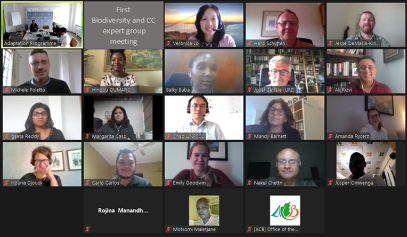
The expert group can help address key knowledge gaps by cross-collaborating with other members, the UNFCCC constituted bodies, other NWP thematic expert groups and relevant communities of practice.
The expert group follows these key principles in undertaking their role:
Composition
The selection criteria for the multidisciplinary thematic expert group members ensure a regional and gender balance, balance in expertise and perspective on the specific thematic areas. This includes:
-
Type of organization (CSO, INGO, UN, IPO, etc.)
The role of expert group is to:
The composition of the expert group on biodiversity is noted in the table below, outlining the organization, the expert representative and their location.
| Affiliation |
Name of expert |
Location |
| Global Water Partnership (GWP) South Africa |
Loreen Katiyo |
South Africa |
| The Center for People and Forests (RECOFTC) |
Ronnakorn Triraganon |
Thailand |
| Adelphi |
Kathrin Ludwig |
Germany |
| The International Union for Conservation of Nature (IUCN) |
Ali Raza Rizvi
Emily Goodwin |
United States |
| ASEAN Centre for Biodiversity |
Therese Mundita S. Lim
James Santiago
Carlo M. Carlos |
Philippine |
| ICIMOD |
Nakul Chettri |
Nepal |
| The Convention on Biological Diversity (CBD) |
Alexander Shestakov |
Canada |
| The United Nations Convention to Combat Desertification (UNCCD) |
Miriam Medel |
Germany |
| Acclimatise |
Amanda Rycerz |
United States |
| Association des Femmes Peules Autochtones du Tchad (AFPAT) |
Hindou Oumar
Balkisou Buba |
Cameroon |
| World Business Council for Sustainable Development |
David Bennell |
United States |
| Centre for International Forestry Research (CIFOR) |
Houria Djoudi |
Indonesia |
| National Environment Management Authority (NEMA) |
Jusper Omwega |
Kenya |
| PlanAdapt |
Jesse DeMaria-Kinney |
Switzerland |
| Wetlands International |
Hans Schutten |
The Netherlands |
| The United Nations Environment Programme (UNEP) |
Michele Poletto
Suyeon Yang |
Kenya |
| Instituto Nacional de Ecologia y Cambio Climatico, Mexico (INECC) |
Margarita Caso |
Mexico |
| The South African National Biodiversity Institute (SANBI) |
Mandy Barnett |
South Africa |
| Centre for Development Research (ZEF), University of Bonn |
Alisher Mirzabaev |
Germany |
| University of Pennsylvania |
Michael Weisberg |
United States |
| WeForest |
Matthias De Beenhouwer |
Zambia |
| IPBES |
Josef Settele |
Germany |
| Indigenous Women’s Biodiversity Network (IWBN) |
Viviana Figueroa |
United States |
| International Institute for Environment and Development (IIED) |
Hannah Reid |
United Kingdom |
| University of Glasgow |
Fabrice Renaud |
United Kingdom |
| The Deutsche Gesellschaft für Internationale Zusammenarbeit GmbH (GIZ) |
Mathias Bertram
Ulrich Kindermann |
Germany |