0
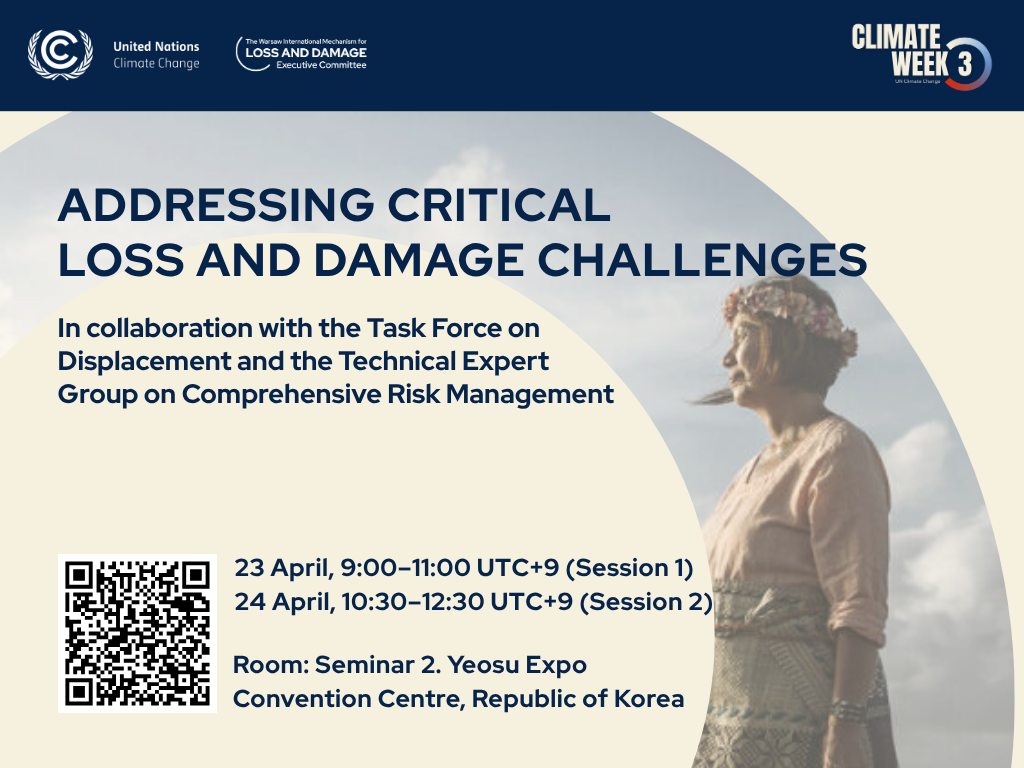
Addressing Critical Loss and Damage Challenges: Human mobility, slow onset events, and non-economic losses
Organized by the Executive Committee of the Warsaw International Mechanism for Loss and Damage (ExCom)
23 - 24 Apr. 2026
Yeosu, Republic of Korea
Republic of Korea
Adaptation & Loss and Damage
English
0
Addressing Critical Loss and Damage Challenges: Human mobility, slow onset events, and non-economic losses
Organized by the Executive Committee of the Warsaw International Mechanism for Loss and Damage (ExCom)
23 - 24 Apr. 2026
Yeosu, Republic of Korea
Republic of Korea
Adaptation & Loss and Damage
English

Access webcast for Session 1 

Presentation slides for Session 1

Access webcast for Session 2

Presentation slides for Session 2
Flyer for Event Climate Week WIM ExCom

Context:

Climate change is increasingly resulting in irreversible changes and complex forms of loss and damage, including displacement, and economic and non-economic losses affecting culture, ecosystems and social well-being.

With the successful completion of the third review of the Warsaw International Mechanism for Loss and Damage associated with the Climate Change Impacts (WIM), the decision adopted at COP 30 reinforces WIM’s role in assisting developing countries navigate the growing realities of loss and damage. Through its thematic expert groups, the WIM Executive Committee has generated a growing body of knowledge on these issues. WIM's technical assistance facility, the Santiago Network, is in full operation with enhanced ability to scale delivery to support countries in averting, minimizing, and addressing loss and damage.

The event is in two sessions to allow engagement with a diverse range of policymakers, practitioners and institutions, working on the core areas of loss and damage, spanning from human mobility, non-economic and irreversible losses, comprehensive risk management and policy integration.

The two-part session is structured around a common thread: translating the growing body of knowledge on loss and damage into practical action at the regional, national and local level. Each session takes a focused, solutions-oriented approach to existing challenges – drawing on country experiences and showcasing ways in which the WIM can strengthen the practical application and accessibility of this knowledge to catalyse implementation support, technical expertise and support available under the WIM. Together, the sessions are designed to contribute to supporting broader efforts to enhance practical action on loss and damage, alongside informing technical guides and ‘How-to' series of knowledge products in the pipeline for publishing this year under the WIM Executive Committee.

Objectives:

Highlight practical challenges and emerging responses to key loss and damage issues across different regional, national and local contexts;

Accelerate the uptake and application of existing knowledge and solutions related to human mobility, comprehensive risk management and responses, and non-economic losses;

Strengthen awareness of implementation support, including those under the WIM and other institutions;

Facilitate dialogue between policymakers, practitioners and experts on practical pathways for addressing complex loss and damage challenges.

Agenda for Session 1

Moderator: Ms. Angela Rivera Galvis, WIM Executive Committee member

Local time UTC+9  Focus
9:00 – 9:10

1.1 Welcome and introduction 

  • Opening remarks, Ms. Ingrid Lundberg, COP 31 Incoming Presidency
  • Opening remarks, Mr. James Thonjo, WIM Executive Committee member
9:10 – 10:10

1.2 Scene-setting for the two sessions: Real-world loss and damage challenges 

  • Ms. Angela Rivera Galvis, WIM Executive Committee member
1.3 Mentimeter live poll, followed by small group reflections 

1.4 Lightning insights: What are the practical challenges and persistent gaps? What are countries and communities experiencing? 

Short inputs on regional-, country-, and local-level experiences, illustrating practical challenges.

  • Mr. Amjad Abdulla, Director General, Ministry of Climate Change, Environment, and Energy from the Republic of Maldives
  • Mr. Rodne Galicha, Local community knowledge holder from Asia
  • Ms. Pema Wangmo Lama, Indigenous knowledge holder from Asia

Q&A and plenary reflection on key bottlenecks, knowledge/support gaps.    

10:10 – 10:40

1.5 Uptake of WIM knowledge resources: how are countries using technical guides and policy-supporting materials? 

Short presentations from countries and practitioners who have used the WIM Executive Committee products to illustrate key takeaways on how countries can utilize the knowledge being made available. 

  • Mr. James Thonjo, Kenya; WIM Executive Committee member
  • Mr. Christopher Richter, IOM, Task Force on Displacement member
  • Mr. Krib Sitathani, Regional Coordinator for Asia Pacific, Climate Promise & SCALA Programmes, UNDP 
10:40 – 11:00 

1.6 Key takeaways and preview of Session 2 

Key takeaways

  • All participants
  • Ms. Serin Oh, MCII, Technical Expert Group on Comprehensive Risk Management member
  • Mr. Christopher Richter, IOM, Task Force on Displacement member
  • Mr. James Thonjo, WIM Executive Committee member

Introduction to Session 2.

Agenda for Session 2

Moderator: Mr. Christopher Richter, IOM, Task Force on Displacement member 

Local time UTC+9  Focus
10:30 – 10:50  2.1 Welcome back and recap of Session 1 
10:50 – 11:00

2.2 What support do practitioners and policymakers actually need? 

  • Mentimeter live poll
11:00 – 11:20

2.3 Lightning insights: What has worked in practice? 

Short inputs from national practitioners on what helped their country move from assessment to action.   

  • Mr. James Thonjo, Kenya; WIM Executive Committee member
  • Dr. Heng Chanthoeun, General Directorate of Policy and Strategy, Ministry of Environment/National Council for Sustainable Development, Cambodia 
  • Mr. Robin Ruben, Adaptation officer/NAP implementation coordinator, PNG Climate Change & Development Authority, Papua New Guinea
11:20 – 11:50

2.4 Connecting WIM’s mandate to country implementation needs and Expert Groups’ implementation support materials in the pipeline 

Connecting WIM's mandate to country implementation needs

  • Ms. Angela Rivera Galvis, WIM Executive Committee member

Implementation support materials in the pipeline under the WIM ExCom’s Expert Groups  

  • Ms. Serin Oh, MCII, Technical Expert Group on Comprehensive Risk Management member
  • Mr. Christopher Richter, IOM, Task Force on Displacement member 
11:50 – 12:20

2.5 World Cafe discussions

Table stations and guiding questions: 

1. Embedding L&D into national planning & using UNFCCC mechanisms

Guiding questions: 

  • How is your country planning to utilize key loss and damage mechanisms under the UNFCCC (i.e. SN, FRLD)? Do you have immediate plans to try to access these mechanisms? 
  • If you had to embed loss and damage into one national document or process in the next year (e.g. BTR, NDC, DRM strategy, a budget cycle), which would it be, and what would you need to do that? 

2. Applying a comprehensive risk management approach

Guiding questions: 

  • Where do you face the biggest challenge in applying a comprehensive risk management approach to loss and damage? (e.g. understanding risk layers or risk instruments, assessing risks, linking sectors, assigning instruments, institutional coordination) 
  • What is the biggest difficulty in managing different types of climate risks and impacts in a coordinated way? (e.g. across sectors, institutions, or types of risk) 
  • What makes it difficult to move from understanding risks to actually getting support or funding to address loss and damage?

3. Priority topics & measurement gaps for future WIM products 

Guiding questions: 

  • What are the top 3 topics future WIM products should prioritize? 
  • What is the single biggest gap in your country’s ability to measure or document loss and damage (including non-economic losses) in a way that decision-makers actually trust and use? 
  • How could WIM products and ‘How to Guides’ support your engagement with access to the support available through the Santiago Network and the Fund for responding to Loss and Damage? 

4. Informing future ‘How -To’ Guides

Guiding questions: 

  • What format would make guidance most usable? (e.g. toolkits, case studies, templates) 
  • How long should a practical guidance ideally be? (e.g. 5 pages? 10? 25+?) 
  • Would interactive tools (e.g., calculators, dashboards) improve usability? 
  • What are the top 3 topics future WIM products should prioritize? 
12:20 – 12:30 

2.6 Closing: from dialogue to implementation 

  • Key takeaways from all participants
  • Ms. Serin Oh, MCII, Technical Expert Group on Comprehensive Risk Management member  
  • Mr. Christopher Richter, IOM, Task Force on Displacement member 
  • Mr. James Thonjo and Ms. Angela Rivera Galvis, WIM Executive Committee members 

Refreshments will be served after both sessions.